The Science of Ocean Sounds for Sleep and Rest

8 min read
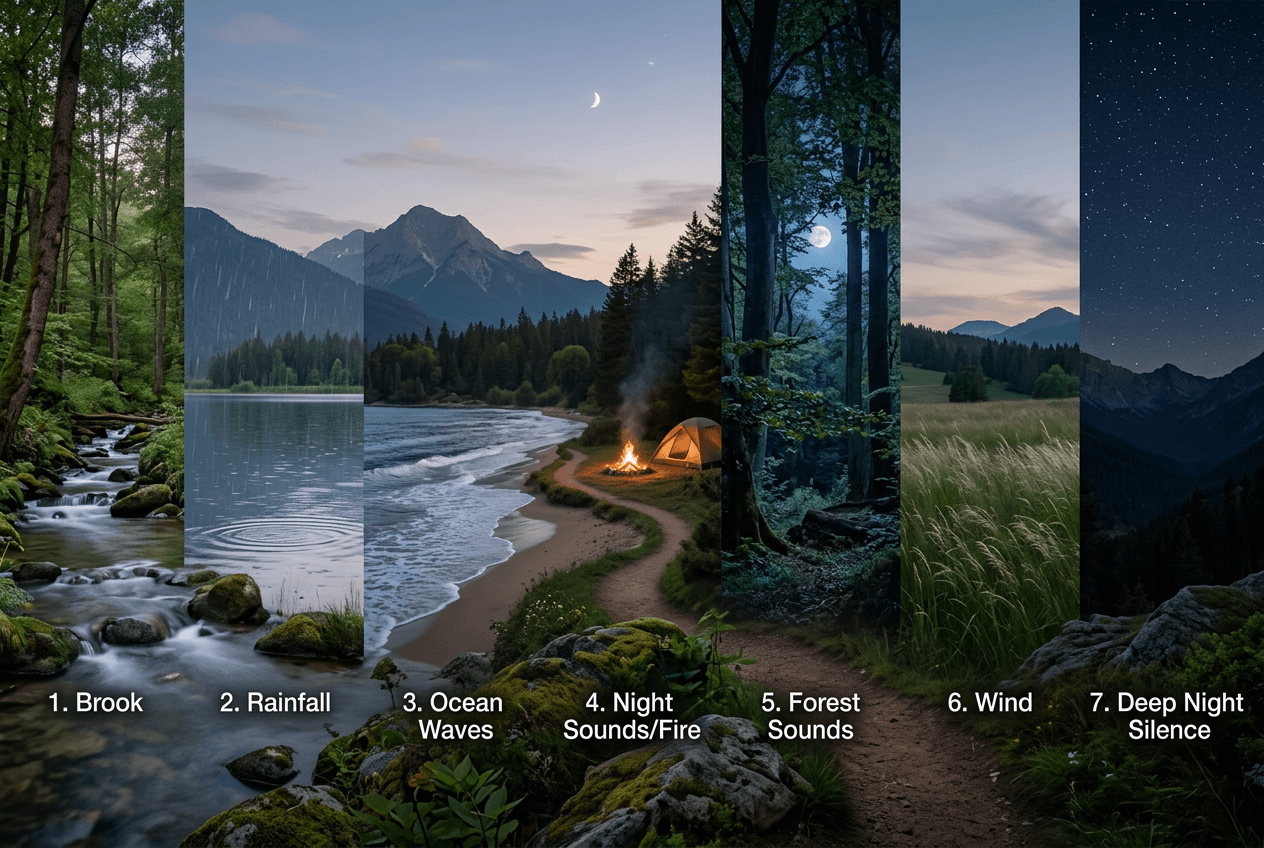
The crash of waves against a shoreline has lulled humans to sleep for thousands of years. In our data-driven ranking of the 7 best nature sounds for sleep, ocean waves consistently place in the top two — here's the deeper science behind why. Long before white noise machines and sleep apps, our ancestors drifted off to the rhythmic pulse of tides, their bodies responding to something primal and deeply encoded. The science behind ocean sounds for sleep reveals a fascinating intersection of evolutionary biology, neuroscience, and acoustic engineering that explains why these soundscapes work so effectively for rest.
What makes wave sounds different from other sleep aids isn't just pleasant ambiance. Research shows that ocean acoustics trigger specific neurological responses that prepare the body for deep, restorative sleep. These aren't random calming noises: they're precisely structured sound patterns that our brains have evolved to interpret as signals of safety and relaxation. Understanding this science can help you harness these sounds more effectively, transforming restless nights into genuinely restorative sleep.
The Evolutionary Link Between Water and Relaxation
The Concept of Blue Mind Theory
Marine biologist Wallace J. Nichols introduced the term "blue mind" to describe the meditative state humans experience near water. His research, spanning over a decade, suggests that proximity to water triggers a mild meditative state characterized by calm, peace, and a sense of general happiness. Brain imaging studies support this: participants viewing or hearing water show increased alpha wave activity, the neural signature of wakeful relaxation. Rainfall produces a very similar response — our guide on why your brain loves the sound of rain for sleep explores the shared mechanisms.
This isn't mere preference or cultural conditioning. The response appears hardwired. Infants with no prior ocean exposure still show measurable relaxation responses to wave recordings. Something about these sounds speaks directly to our nervous system, bypassing conscious thought entirely.
Ancestral Safety and Rhythmic Predictability
Our evolutionary relationship with water shaped how we process its sounds. For early humans, the presence of water meant survival: hydration, food sources, and defensible territory. Settlements near coastlines offered predictable tidal patterns that signaled environmental stability.
The rhythmic predictability of waves matters enormously. Unlike sudden sounds that trigger alertness, ocean waves follow consistent patterns. The brain learns to predict the next wave, reducing the cognitive load required for environmental monitoring. This predictability signals safety at a subconscious level, allowing the nervous system to shift from vigilant scanning to restful processing. Your brain essentially receives permission to stand down from threat detection, enabling the transition into sleep.
Neurological Impact of Ocean Soundscapes
Pink Noise and Brain Wave Synchronization
Ocean sounds fall into a category called pink noise, which differs significantly from white noise. For a full breakdown of how the noise colors compare for sleep, see our guide on white, pink, and brown noise. While white noise contains equal energy across all frequencies, pink noise has more power in lower frequencies, creating a deeper, more natural sound profile. This matches how we hear: our ears are more sensitive to higher frequencies, so pink noise sounds balanced and organic.
Research published in Frontiers in Human Neuroscience found that pink noise exposure during sleep increased stable sleep time and improved memory recall by up to 25%. The brain waves of sleeping participants actually synchronized with the rhythm of the pink noise, creating a phenomenon called entrainment. Ocean waves, with their roughly 10-12 second cycles, happen to match the frequency of slow-wave sleep patterns remarkably well.
Parasympathetic Nervous System Activation
The autonomic nervous system governs involuntary functions like heart rate, digestion, and breathing. It operates in two modes: sympathetic (fight-or-flight) and parasympathetic (rest-and-digest). Ocean sounds consistently trigger parasympathetic activation.
Studies measuring heart rate variability show that wave sounds increase parasympathetic tone within minutes of exposure. Heart rate slows, blood pressure drops, and breathing deepens. These aren't subtle effects: one study recorded an average heart rate reduction of 8 beats per minute within the first five minutes of ocean sound exposure. The body physically prepares for rest without any conscious effort required.
Reduction of Cortisol and Stress Biomarkers
Cortisol, the primary stress hormone, follows a natural daily rhythm. It should peak in the morning and decline throughout the day, reaching its lowest point during sleep. Chronic stress disrupts this pattern, keeping cortisol elevated when it should be dropping.
Ocean soundscapes help restore normal cortisol patterns. A 2019 study in Scientific Reports found that participants exposed to natural water sounds showed significantly lower evening cortisol levels compared to control groups. The effect persisted even after the sounds stopped, suggesting that the exposure reset stress hormone regulation rather than simply masking symptoms temporarily.
Acoustic Masking and Sleep Quality
Smoothing the Sound Environment
Urban environments present a particular challenge for sleep. Traffic, neighbors, appliances, and street noise create an unpredictable acoustic landscape that keeps the brain in monitoring mode. Even when you don't consciously hear these sounds, your auditory system processes them, fragmenting sleep architecture.
Ocean sounds work as acoustic masking agents, filling the auditory space with consistent, non-threatening input. The brain still processes the sound, but because waves are predictable and safe, no alerting response triggers. Background disturbances get absorbed into the overall soundscape rather than standing out as potential threats requiring attention.
Preventing Sudden Arousal from Peak Noises
Sleep researchers distinguish between average noise levels and peak noise events. A room might average 35 decibels, but a car horn reaching 70 decibels creates a 35-decibel spike. These spikes cause microarousals, brief awakenings that fragment sleep without necessarily bringing you to full consciousness.
Ocean sounds reduce the perceived magnitude of these spikes. If your baseline sound environment sits at 50 decibels of wave sounds, that same car horn now represents only a 20-decibel increase rather than 35. The relative change matters more than absolute volume. By raising the ambient floor, ocean sounds compress the dynamic range of your sleep environment, preventing the startle responses that degrade sleep quality.
Psychological Benefits Beyond Sleep
Enhancing Focus and Cognitive Rest
The benefits of ocean soundscapes extend well beyond nighttime sleep. Many people report improved concentration during work or study when listening to wave recordings. This isn't placebo: the same mechanisms that prepare the brain for sleep also support focused cognitive work.
The key is arousal level. Peak mental performance occurs at moderate arousal: too low and you're drowsy, too high and you're anxious. Ocean sounds help regulate arousal to this optimal middle zone. They're stimulating enough to prevent drowsiness but calming enough to reduce anxiety and mental chatter. Students using ocean sounds during study sessions show improved information retention compared to silence or music with lyrics.
Facilitating Deep Meditation States
Experienced meditators have used ocean sounds for centuries to deepen practice. The rhythmic quality provides an anchor for attention without demanding active engagement. Unlike guided meditations or music, waves offer consistent support without narrative content that might distract.
Brain imaging of meditators using ocean sounds shows faster transition into theta wave states, the neural signature of deep meditation. Regular practitioners report that wave sounds help them access meditative states more quickly and maintain them longer. The sounds essentially provide training wheels for the brain, guiding it toward the desired state through acoustic entrainment.
Optimizing Your Auditory Sleep Environment
Selecting High-Fidelity Audio Sources
Not all ocean recordings work equally well. Low-quality recordings compress audio frequencies, removing the subtle variations that make waves sound natural. Your brain detects this artificiality, even subconsciously, reducing the relaxation response.
Look for recordings with these characteristics:
- Sample rates of at least 44.1 kHz, matching CD quality
- Minimal or no looping, as repeated patterns become detectable
- Full frequency range including deep bass tones below 100 Hz
- Field recordings from actual locations rather than synthesized sounds
- Duration of at least 8 hours to prevent silence during the night
Streaming services often compress audio significantly. Downloading high-quality files or using dedicated sleep sound apps typically produces better results than streaming through music platforms.
Ideal Volume Thresholds for Rest
Volume matters more than most people realize. Too quiet and the masking effect fails. Too loud and the sound itself becomes stimulating rather than calming.
Research suggests optimal sleep sound levels between 40-50 decibels, roughly equivalent to a quiet conversation or light rainfall. You should be able to hear the waves clearly but not feel overwhelmed by them. A good test: if you have to raise your voice to talk over the sound, it's too loud. If you can easily forget it's playing, you've found the right level.
Position speakers or your phone away from your head, ideally across the room. This creates a more natural soundscape and prevents localized sound from one direction, which can feel artificial and distracting.
Creating Your Ideal Sleep Soundscape
The science of ocean sounds for sleep and rest points to something our ancestors knew intuitively: water sounds prepare the human body for deep, restorative rest. From evolutionary safety signals to precise neurological effects, waves work on multiple levels simultaneously.
Start experimenting with high-quality recordings at appropriate volumes. Pay attention to which specific ocean sounds work best for you: some people prefer gentle lapping waves while others respond better to distant surf. Give your brain several nights to adapt to the new soundscape before judging effectiveness. The cumulative benefits often take a week or two to fully manifest, as your nervous system learns to associate these sounds with sleep.
Your path to better rest might be as simple as the sound of waves meeting shore.