How Forest Sounds for Sleep Reduce Your Cortisol

8 min read
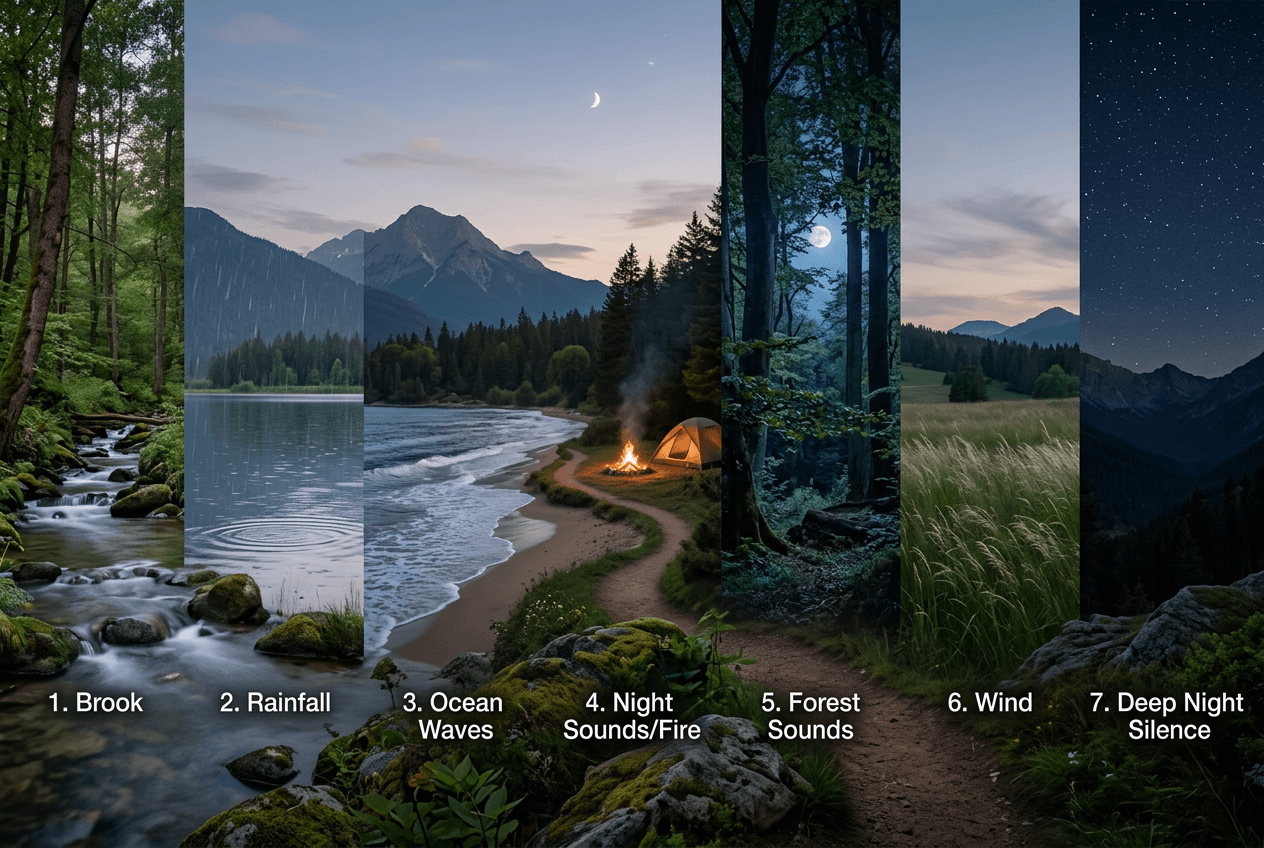
Your brain knows something you've probably forgotten: the forest is safe. Forest sounds rank among the top performers in our data-driven guide to the 7 best nature sounds for sleep — here's the deeper science behind why. For hundreds of thousands of years, our ancestors fell asleep to rustling leaves, distant streams, and the quiet hum of nocturnal wildlife. These sounds signaled that predators weren't nearby and that the environment was stable enough for rest. Modern sleep research is catching up to this ancient wisdom, revealing that forest sounds for sleep do more than mask urban noise. They actively reduce cortisol, the hormone that keeps you wired and alert when you should be drifting off. Nature audio works on a neurological level, triggering responses that synthetic sounds simply can't replicate. If you've ever wondered why a recording of rainfall or wind through trees feels so different from white noise machines, the answer lies in how your nervous system evolved to interpret acoustic information.
The Connection Between Nature Soundscapes and Stress Reduction
Understanding Cortisol: The Body's Stress Command Center
Cortisol gets a bad reputation, but it's essential for survival. This hormone wakes you up in the morning, helps you respond to threats, and regulates inflammation. Problems arise when cortisol stays elevated at night, which happens to roughly 30% of adults dealing with chronic stress. Elevated evening cortisol delays sleep onset, reduces time spent in deep sleep stages, and causes those 3 AM wake-ups that leave you staring at the ceiling.
The relationship between sound and cortisol is direct. Sudden, unpredictable noises trigger cortisol spikes as your brain assesses potential threats. Urban environments bombard us with these alerts: car horns, sirens, slamming doors, neighbor conversations through thin walls. Each sound requires your brain to evaluate danger, even while you sleep. Forest soundscapes work differently because they contain no threat signals your brain recognizes.
Psychoacoustics: Why Our Brains Prefer Organic Patterns
Psychoacoustics studies how we perceive and respond to sound, and researchers have identified key differences between natural and artificial audio. Natural sounds contain fractal patterns, meaning their acoustic structures repeat at different scales. The rustle of leaves contains tiny variations within larger rhythmic patterns. Your brain recognizes these as organic and non-threatening.
Artificial sounds, even pleasant ones, often lack this complexity. A synthesized tone holds steady, which your brain interprets as artificial and potentially worth monitoring. Studies from Brighton and Sussex Medical School found that natural sounds shift brain activity toward outward-focused attention, the state associated with relaxation. Artificial sounds pushed attention inward, a pattern linked to anxiety and rumination. This isn't preference or nostalgia. Your auditory cortex processes these sound categories through entirely different neural pathways.
How Forest Auditory Cues Shift the Nervous System
Activating the Parasympathetic Response for Rest
Your autonomic nervous system has two modes: sympathetic (fight-or-flight) and parasympathetic (rest-and-digest). Quality sleep requires parasympathetic dominance, characterized by slower heart rate, deeper breathing, and reduced muscle tension. Forest sounds consistently activate this parasympathetic response in controlled studies.
Research published in the International Journal of Environmental Research and Public Health measured heart rate variability in subjects exposed to different soundscapes. Those listening to forest recordings showed increased HRV within minutes, indicating parasympathetic activation. The effect was measurable even when participants weren't consciously paying attention to the audio. Their nervous systems responded automatically to acoustic cues that signaled environmental safety.
The Evolutionary Theory of Safety in Nature Noises
Why would birdsong or flowing water signal safety? Evolutionary biologists point to consistent patterns across species. Birds fall silent when predators approach. Water sounds indicate proximity to essential resources. Wind through vegetation suggests open space with good visibility. These associations aren't learned. They're inherited from ancestors who survived because their nervous systems correctly interpreted environmental audio.
This theory explains why nature audio reduces cortisol more effectively than silence. Silence itself can signal danger, as prey animals go quiet when threats appear. A forest soundscape tells your ancient brain that the environment is actively safe, not just absent of obvious threats. This distinction matters for sleep, where your brain continues monitoring for danger throughout the night.
Specific Forest Sounds That Lower Cortisol Levels
Rustling Leaves and Gentle Wind: Creating a Pink Noise Effect
Not all forest sounds work equally well. Rustling leaves and wind through trees produce what acousticians call pink noise, a frequency distribution where lower frequencies are more prominent than higher ones. For more on why this frequency profile is so effective, see our guide on white, pink, and brown noise for sleep. Pink noise matches the spectral distribution of many natural phenomena and aligns with how human hearing perceives balanced sound.
White noise contains equal energy at all frequencies, which can feel harsh or hissy. Pink noise feels warmer and more enveloping. Studies comparing pink noise to white noise for sleep found that pink noise increased deep sleep duration by up to 23% in some participants. The gentle variations in leaf rustle add another layer: your brain stays engaged enough to avoid the startle response that sometimes occurs with perfectly uniform sound, while remaining relaxed because the variations follow predictable organic patterns.
Flowing Water and Distant Birdsong: Rhythmic Relaxation
Water sounds, whether streams, light rain, or distant waterfalls, provide rhythmic consistency that helps regulate breathing. We explore the specific neuroscience of rainfall in our piece on why your brain loves the sound of rain for sleep. Many people unconsciously synchronize their breath to repetitive sounds, and slower breathing directly activates parasympathetic responses. The gurgle of a stream provides enough variation to prevent monotony while maintaining a steady underlying rhythm.
Birdsong works through a different mechanism. Dawn chorus recordings contain complex acoustic information that occupies your auditory attention without demanding conscious processing. This prevents your mind from wandering into anxious thought loops while avoiding the cognitive load of speech or music. The key is distance: close, loud birdsong can be alerting, while distant calls integrated into a broader soundscape enhance the sense of peaceful environment.
Optimizing Your Sleep Environment with Forest Audio
The Importance of Loop Continuity and Audio Quality
Poor-quality recordings undermine the benefits of nature sounds. Obvious loops where the same bird call repeats every thirty seconds teach your brain to anticipate the pattern, which requires active attention. Compression artifacts, the digital distortion from heavily compressed audio files, introduce frequencies that don't exist in nature and can trigger subtle stress responses.
Look for recordings of at least thirty minutes without obvious repetition. High-quality nature audio uses field recordings with minimal processing, preserving the full frequency range your ears expect from real environments. Some apps and services now use algorithmic generation to create infinite non-repeating soundscapes, which can work well if the underlying samples are high quality.
Volume Calibration for Deep Sleep Induction
Volume matters more than most people realize. Too loud, and the sound becomes a presence that demands attention. Too quiet, and it fails to mask disruptive environmental noise. The ideal volume is just loud enough to hear clearly when you focus on it, but quiet enough to fade into the background when you don't.
A practical calibration method: set the volume so that normal conversation would be easily audible over the recording. This typically falls between 30-50 decibels, roughly the level of a quiet library. If you're using nature sounds primarily for noise masking, you may need slightly higher volume, but avoid exceeding 60 decibels. Sustained exposure to louder sounds can actually increase cortisol over time.
Long-Term Health Benefits of Nature-Induced Sleep
Breaking the Chronic Stress Cycle
Chronic stress creates a feedback loop: elevated cortisol disrupts sleep, poor sleep increases stress sensitivity, and increased stress elevates cortisol further. Breaking this cycle requires intervention at multiple points. Nature soundscapes address the sleep component directly while also reducing cortisol during waking hours when used for relaxation.
Consistent use matters more than occasional exposure. Research on forest bathing, the Japanese practice of spending time in wooded environments, shows that cortisol reduction benefits accumulate over weeks of regular practice. Audio exposure likely works similarly. Using forest sounds nightly for several weeks may reset your baseline stress response more effectively than sporadic use during particularly stressful periods.
Improving Sleep Architecture and REM Cycles
Sleep architecture refers to the progression through sleep stages during the night. Healthy sleep moves through light sleep, deep sleep, and REM cycles in predictable patterns. Elevated cortisol disrupts this architecture, reducing time in restorative deep sleep and fragmenting REM periods.
By lowering cortisol before and during sleep, nature audio helps normalize sleep architecture. Some studies show increased slow-wave sleep, the deepest and most physically restorative stage, in subjects using natural soundscapes. Others demonstrate more consolidated REM periods, which benefits memory consolidation and emotional regulation. These improvements compound over time, as better sleep tonight means lower baseline stress tomorrow.
Making Forest Audio Work for You
The science supporting nature sounds for better sleep and cortisol reduction is substantial, but implementation matters. Start with high-quality recordings that run continuously through the night. Set volume low enough to become background rather than foreground. Give the practice at least two weeks before evaluating results, as your nervous system needs time to recognize the new acoustic environment as consistently safe.
Consider combining audio with other sleep hygiene practices: consistent bedtimes, cool room temperature, and limited screen exposure before bed. Forest soundscapes work best as part of a broader approach rather than a standalone solution. Your brain evolved expecting certain conditions for safe sleep. Recreating those acoustic conditions is one piece of honoring that evolutionary inheritance.